Reviewing & collaboration
Changes don't go live silently. Approvers see exactly what changed, can discuss it in context, and decide when it ships.
Reading the change
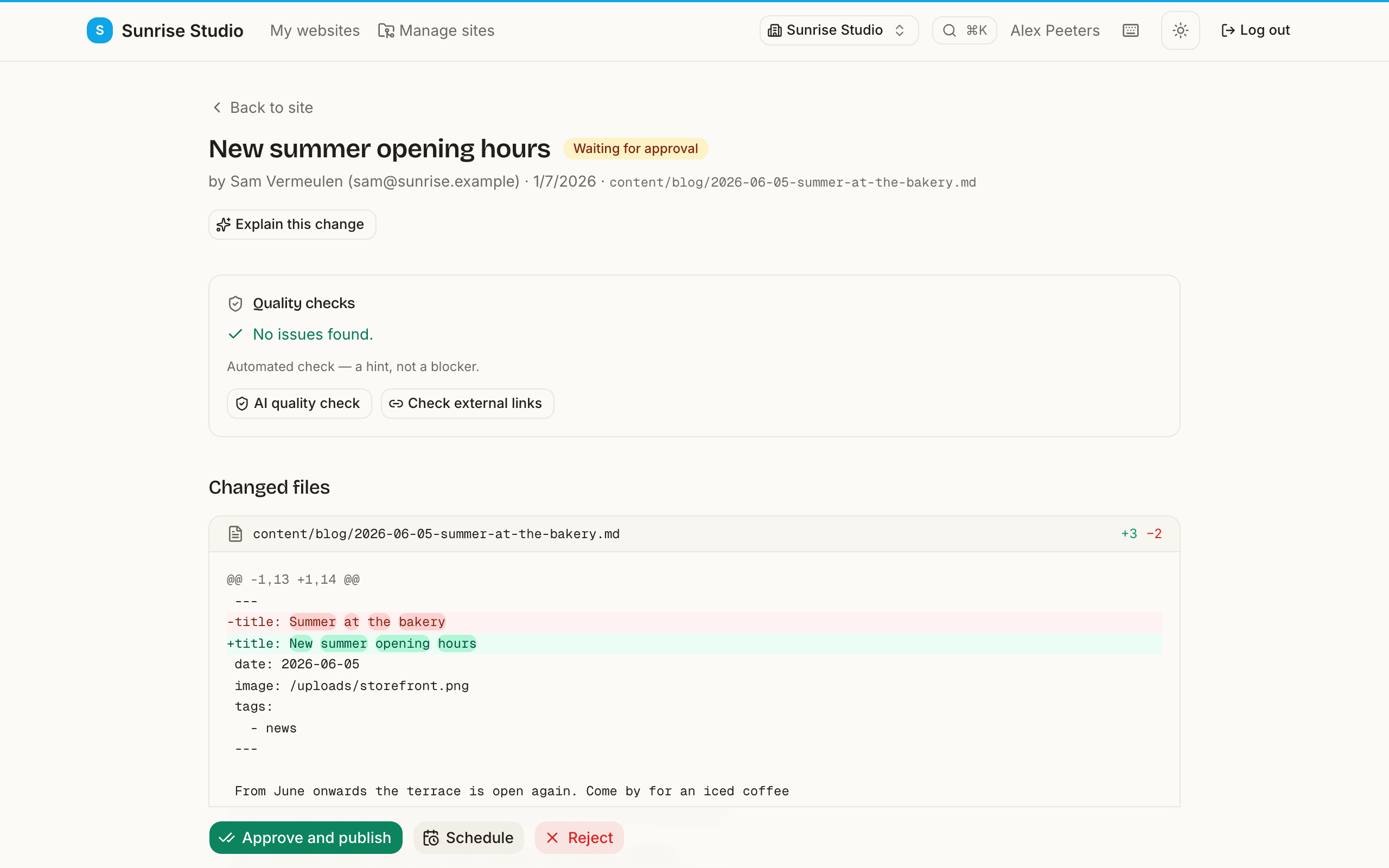
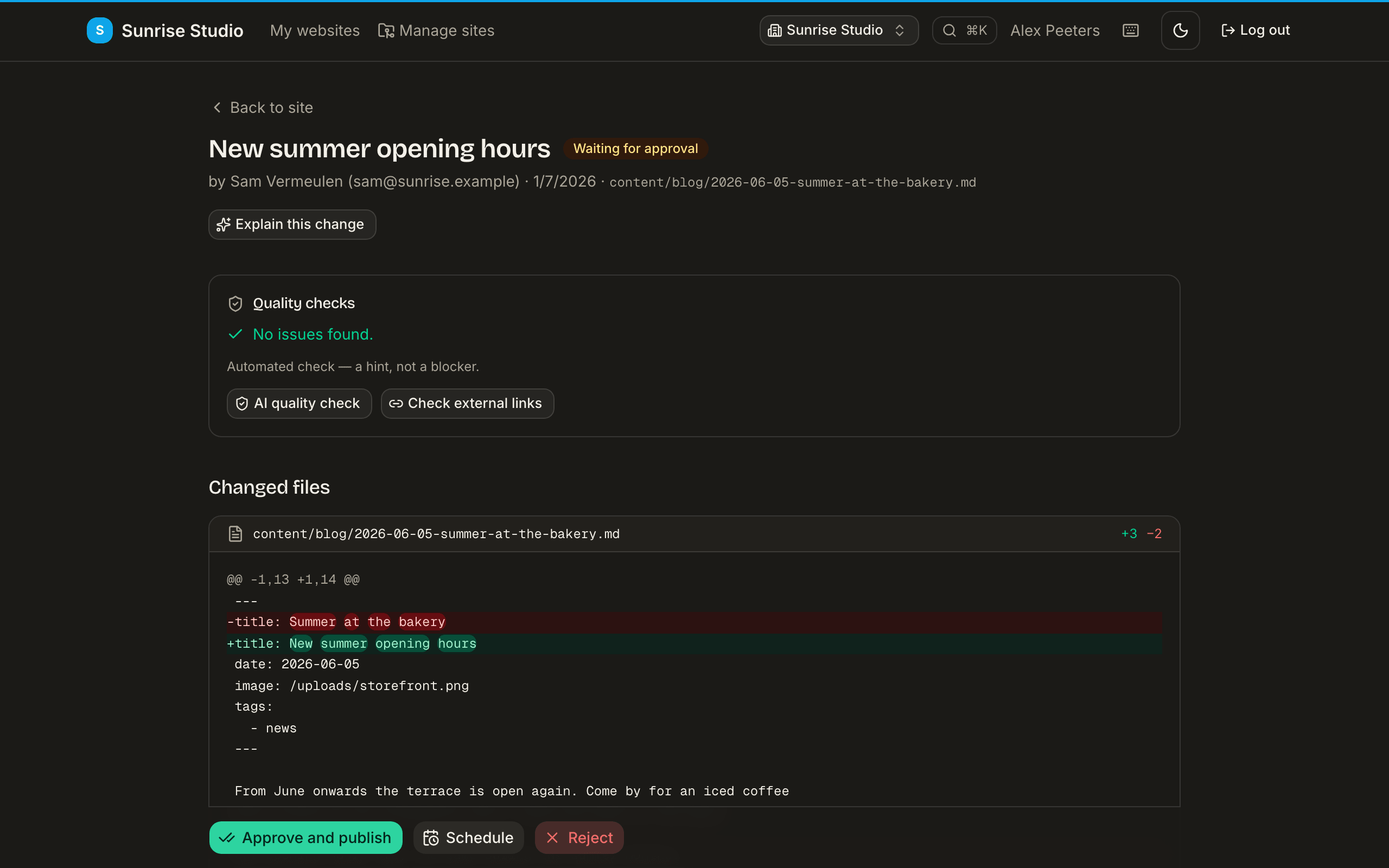
A change's review page shows the exact differences. Added text is highlighted in green, removed text in red, and within a changed line the specific wordsthat changed are highlighted too — so you don't have to hunt through a wall of red and green to see the real edit.
Comments & teamwork
On the review page you can:
- Leave comments to discuss the change in context.
- @mention a colleague — they get an email and see it on their dashboard.
- Assign a comment as a task to someone.
- Mark threads resolved, or reopen them.
The editor who wrote the change can follow along too (they see the diff and the discussion), so feedback happens in one place instead of over email.
When two people edit the same entry
Opening an entry a colleague is already working on doesn't start a silent tug-of-war. You see who's editing right away, before you type a word, and you choose:
- Watch — the entry opens read-only while your colleague works.
- Take over — you become the editor. Your colleague gets a friendly notice that you took over, and their unsaved work stays safe on their device so nothing is lost.
When someone stops editing (or just walks away), the entry frees up by itself and whoever is watching can start editing.
And if an entry still changes under you — say someone published an update to it while you had it open? If you each touched different fields, both changes are combined automatically and you never notice. Only when you both changed the same field do you get a plain-language compare-and-choose screen: your version and the other version side by side, differences highlighted word by word. Pick per field which one to keep, adjust anything you like, and save again. No technical vocabulary, nothing lost either way.
AI helpers (on paid plans)
Plain-language summary
Click Explain this changefor a short, plain-language summary of what actually changed — useful when you're approving and don't want to read a technical diff.
AI quality check
Click AI quality checkto have the content reviewed for readability, passive voice, weak or missing alt text, heading structure and SEO — and against your site's brand voice, if one is configured. It's advice, not a gate: you still decide.
Reviewing AI-authored changes
Some changes are drafted by an AI assistant rather than typed by a person — and PullPress makes that obvious so you can review with the right amount of scrutiny.
- Drafted by AI card. When a change was written by a connected assistant (see AI & assistants), the review page shows a Drafted by AI panel with the model, the brief it worked from, any sources it used, and a confidence level. It's an assistant working with a person's permissions, so it still lands as a change you approve — nothing goes live without a human on review sites.
- Stale-content refresh. If an administrator turned on AI refresh, the weekly freshness scan can submit a lightly refreshed draft of a badly outdated entry. It arrives from PullPress AI as an ordinary change for you to review — approve it, tweak it, or reject it. It only touches clearly-dated details and never publishes on its own.
The quality gate
An administrator can turn on a quality gatein a site's settings. When it's on, a change can't be published until the automatic quality checks pass — so issues like missing alt text are fixed before anything goes live.
Approving, rejecting & scheduling
If you can publish, the review page lets you:
- Approve and publish — the change goes live.
- Reject with a reason — it goes back to the editor under To rework on their dashboard, with your note attached.
- Schedule — approve now, publish automatically at a later moment.
Everyone involved gets notified of the decision (by email, and in your team's channel if a webhook is set up).