Saving, submitting & publishing
Your work is always safe. Behind the scenes every change becomes a real branch, and submitting opens a pull request — but you only ever see drafts, review and publish.
From first word to live page
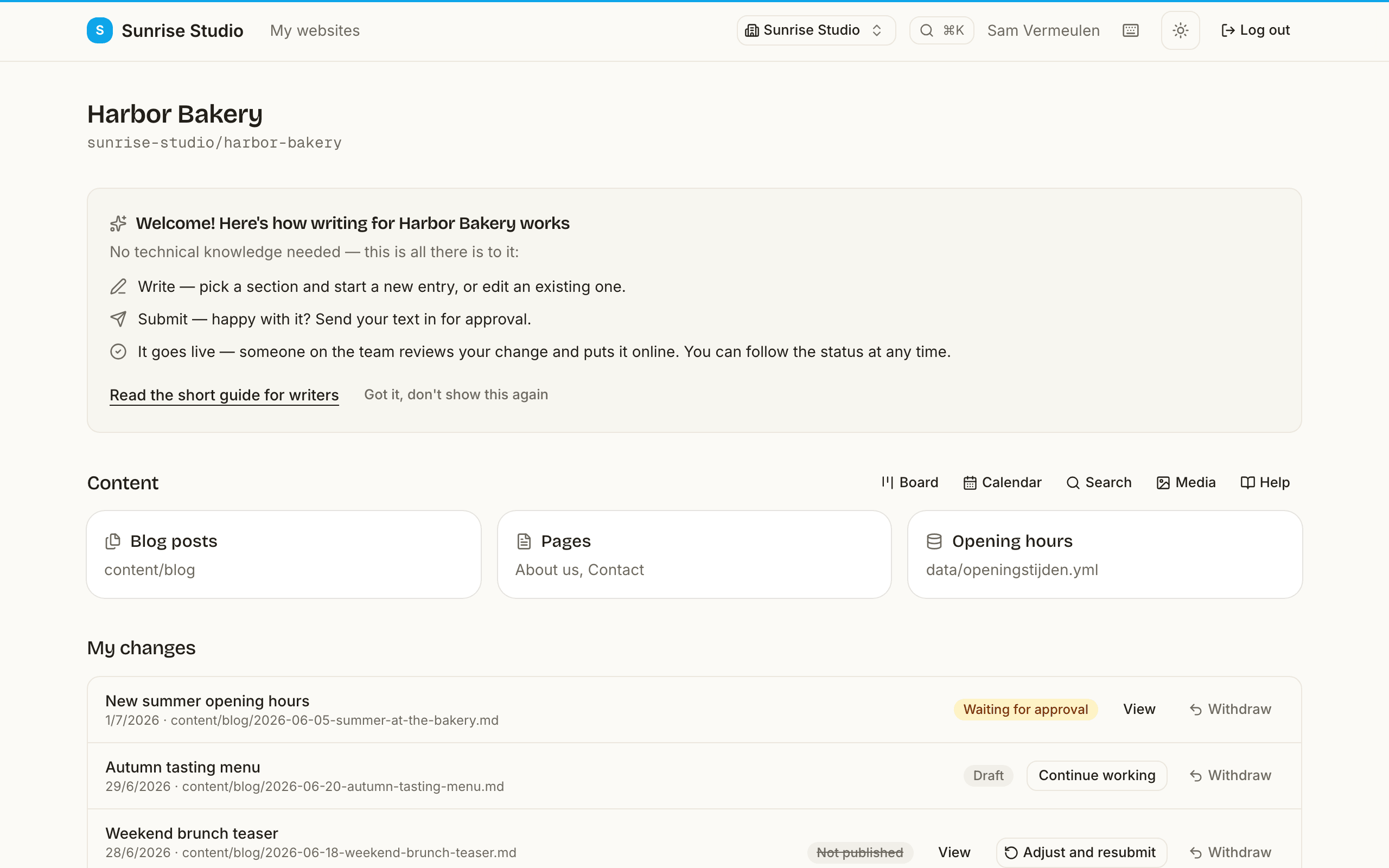
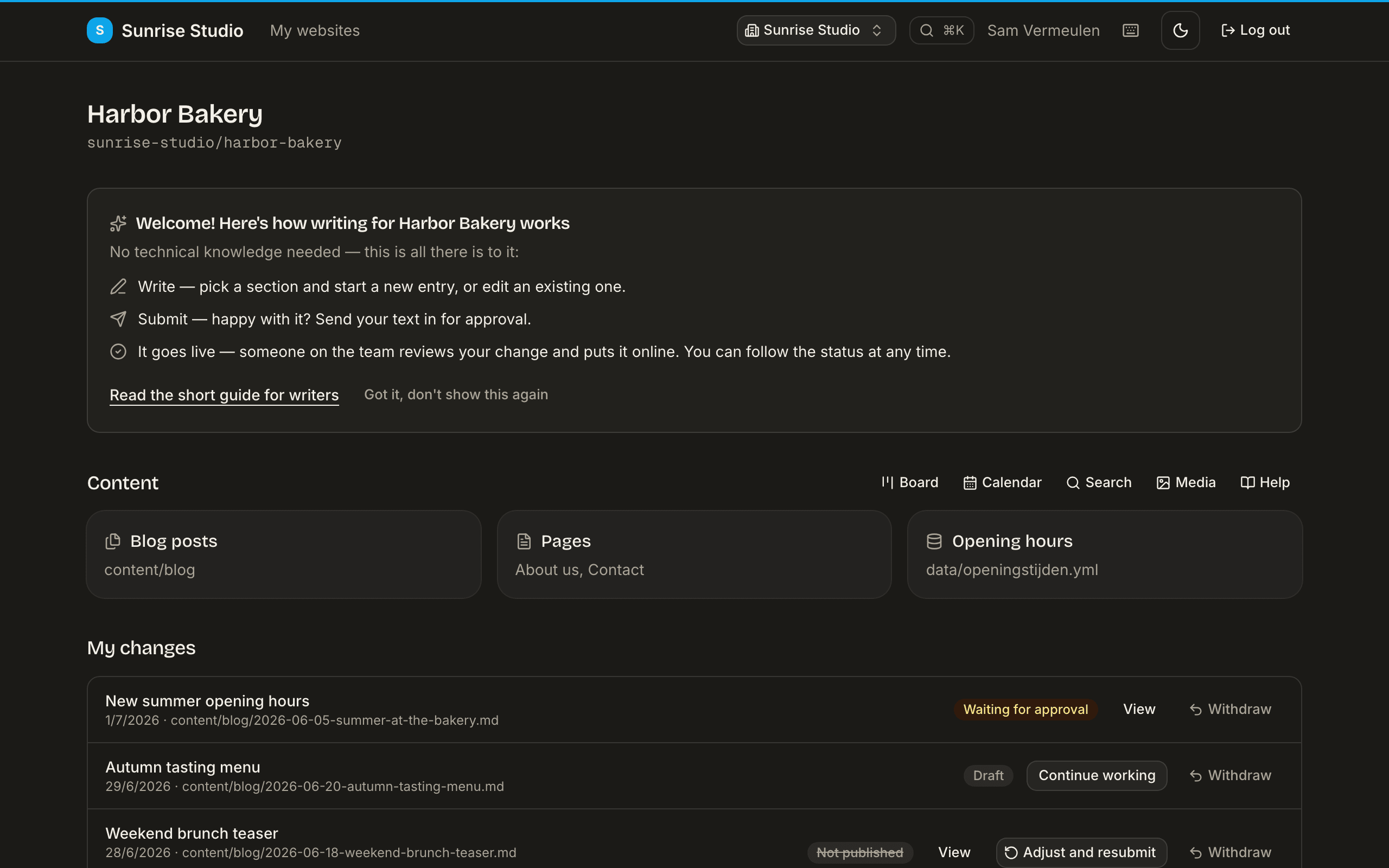
A typical change makes this journey — you can follow it at every step from your dashboard or the site page:
- Write. Open an entry (or start a new one) and write. Your work saves as a private draft.
- Submit. Happy with it? Click Submit for approval. The change now shows Waiting for approval and an approver gets notified.
- Sent back?If the approver isn't convinced yet, the change comes back as Not published, always with a note explaining why. Click Adjust and resubmit, make the fix, and submit again — nothing is lost.
- Published.Once approved, the change goes live. If going live takes a moment you'll see Publishing…in between; when it's done, the status flips to Published.
Autosave & restore
Press ⌘/Ctrl + S to save a draft at any time. A small indicator shows whether you have unsaved changes, are saving, or are all saved. If your browser closes unexpectedly, the editor offers to restore your unsaved work the next time you open the page.
The action bar
At the bottom of an entry you'll find up to three buttons, each with a tooltip explaining it:
- Save draft — keeps your work privately. No one else sees it yet, and you can continue later from your dashboard.
- Submit for approval — sends the change to an approver, who reviews and publishes it.
- Publish now — only for publishers/admins (and only on sites set up for it); puts the change live straight away.
Want to undo everything since you opened the entry? Use Discard changes in the action bar to reset the whole form to how it was.
Statuses
Every change moves through a clear status:
- Draft — saved, visible only to you (and admins).
- Waiting for approval — submitted and waiting for an approver.
- Publishing… — approved, and going live is taking a little longer than usual. Nothing to do: it finishes automatically.
- Publish failed — we're on it— going live keeps failing for the moment. The site admins have been alerted and PullPress keeps retrying in the background; your text is safe and you don't need to do anything.
- Published — approved and live on the site.
- Not published — sent back with a reason, ready for you to rework and resubmit.
Working on the same entry
Two people can never silently overwrite each other. When you open an entry a colleague is already editing, PullPress tells you: “… is editing this right now. You can watch, or take over editing.” Watching is read-only and updates live; Take over makes you the editor — your colleague sees who took over, and their unsaved work stays safe on their device.
If an entry changed on the site whileyou were working on it (for example, someone edited it on GitHub), saving doesn't overwrite anything. Instead the editor shows “This entry was changed by someone else while you were working” and lets you compare the two versions field by field — Your version next to The other version — and choose which one to keep. Click Use the chosen versions, check the result, and save again.
Renaming & duplicating
Open an entry and you'll find two more actions next to it (for entries that live as their own file — blog posts, news, team members):
- Rename— change an entry's name. Because the name is also its file, this usually changes the page's URL on your live site, so existing links to the old address will break. PullPress warns you before you confirm; use it deliberately, and update any hardcoded links yourself. The rename goes through the normal review flow like any other change.
- Duplicate — one click makes a copy titled “Copy of …” and drops you straight into it as a fresh draft. Everything is copied — all fields, the body, and (for entries that keep images in their own folder) their media too — so it's the quickest way to start a new entry from one shaped just right.
Bulk actions
Need to remove several entries at once? In a collection list, tick the checkboxes next to them and use Delete selected— they're bundled into a single change that goes through the normal review flow, just like any other edit.
History & restoring
Because every change is a real commit, each entry keeps a full history. Open an entry's history to see who changed what and when, and to restore an earlier version if you need to roll something back — again, as a reviewable change.
Next: reviewing & teamwork →